
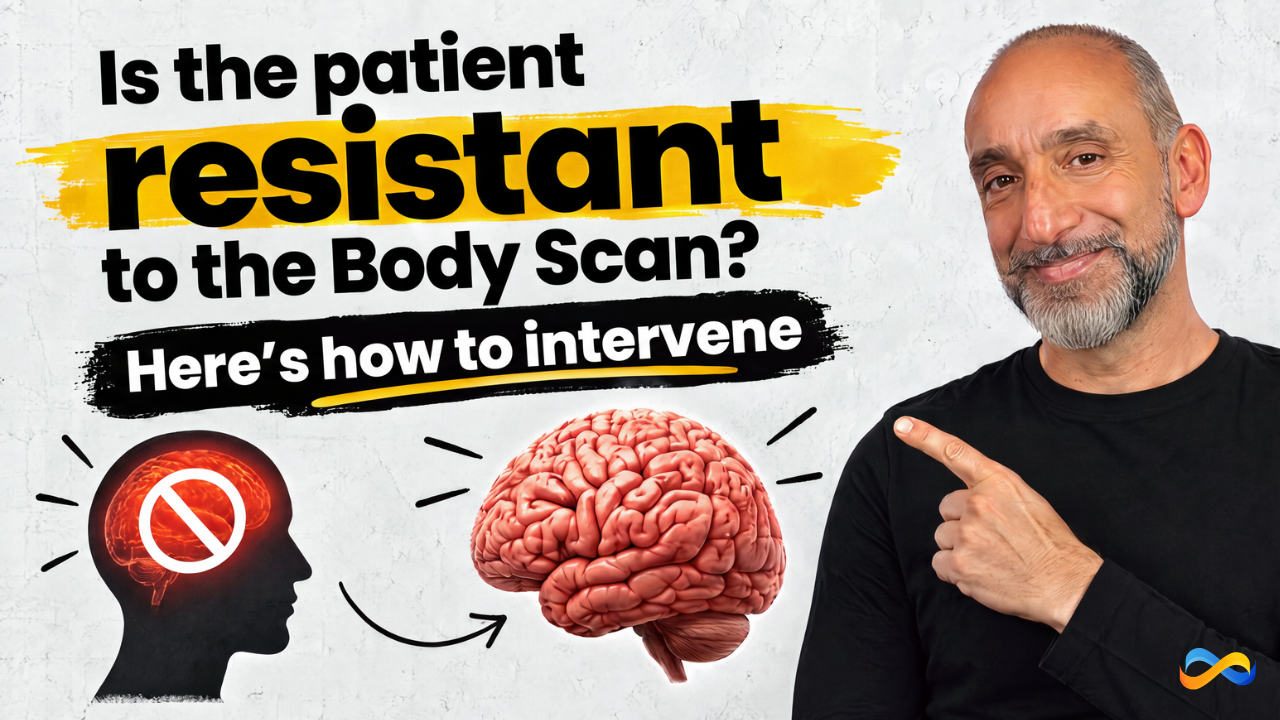
Body Scan: What If We Could Discover Much More?
Oct 29, 2026Body Scan: What If We Could Discover Much More?
How to turn a body scan from a simple observation of sensations into a more differentiated form of exploration. In this video, I propose a small tactile and proprioceptive experiment, with useful implications for clinical work as well.
Below the video, you’ll find:
-
Further resources
-
The link to download a PDF with the key points, guidelines, and reflection question
When “I don’t feel anything” doesn’t tell the whole story
Have you ever asked a client what they notice in their body during a body scan, only to hear: “I don’t feel anything”?
Or, at the opposite end of the spectrum, to hear the same descriptions over and over: “Tension in my shoulders,” “a weight on my chest,” “a knot in my stomach.”
These are perfectly genuine responses. But sometimes they remain at a fairly generic level of description.
Body scans are a valuable technique. They can help develop body awareness and the ability to observe sensations without necessarily needing to change them. Still, I often wonder whether we can take one step further: moving from simply noticing a sensation to distinguishing some of its specific qualities.
Noticing is not the same as distinguishing
Paying attention to a sensation does not automatically mean understanding its nature.
If someone says, “I feel a block in my shoulder,” that’s a useful starting point. But what exactly does “block” mean? Is it muscular contraction? Pressure? A sensation that is difficult to locate? A movement that feels restricted?
These possibilities are not equivalent. And they may not call for the same kind of intervention.
Rather than simply observing, or asking a series of questions whose answers risk becoming increasingly mental rather than experiential, we can explore the sensation by introducing small variations.
A small experiment
If it feels comfortable, rest one forearm on a surface, or simply keep it relaxed.
For a few seconds, bring your attention to that forearm without doing anything else. You may notice temperature, the contact with your clothing, or a slight sense of tension. Or you may notice almost nothing. Both experiences are fine.
Now gently place the fingertips of your other hand on your forearm. Pause for a moment and notice what the contact feels like. Then slowly move your fingers a few centimeters.
Ask yourself: can you perceive any difference between the first point and the one you are touching now?
The texture, perceived temperature, or sensitivity to touch may change. In one spot, the sensation may feel more defined; in another, less so. There is no right answer. What matters is the comparison.
When we compare two conditions, we can often notice qualities that were not apparent when we considered a sensation on its own.
Adding movement
Keep your hand resting on the same point of your forearm. This time, don’t move it.
Instead, slowly open and close the fingers of the hand you are exploring. You can also gently make a fist and then release it.
Notice what happens beneath the hand that remains in place. You may perceive a change in tension, movement in the tissues, or the alternation between contraction and release.
Then stop. How does the sensation feel now, compared with when your arm was completely still?
It is a very simple exercise, but it contains an important principle: when we explore a surface through touch, we use different movements to gather different kinds of information. This phenomenon is well documented in research on active tactile perception.
When we explore our own body, we can combine tactile information, proprioceptive information related to position and movement, and internal sensations.
The goal is not to feel something more intense. It is to learn to perceive with greater differentiation.
Why this can be useful in psychotherapy
When someone describes tension during an emotionally difficult situation, we can explore whether that tension changes with a small movement, a different position, or a variation in touch.
These observations should never be interpreted automatically.
Tension in the shoulder does not necessarily mean that someone is defending themselves against another person. A physical change while talking about a conflict does not prove that we have uncovered a traumatic memory.
We can formulate hypotheses, explore them, and see whether they hold up in the person’s actual experience.
From sensory touch to affective touch
So far, we have focused mainly on physical perception. But that same hand can become more than a tool for gathering sensory information.
Touch can evoke affective and relational experiences.
Once the right conditions are in place, we can introduce different questions:
-
“How do you experience your hand touching you in this moment?”
-
“Does it feel like a neutral, exploratory gesture, or does it also have an emotional quality?”
-
“Is there something you would like to do with that hand? Support, hold, push away?”
-
“And what would you need to receive instead?”
In some cases, needs for protection, care, or closeness may emerge. In others, discomfort, mistrust, an impulse to move away from the touch, or specific memories may appear. And sometimes nothing in particular comes up.
We should not expect every sensation to carry an emotional meaning. But when something does emerge, we can explore it gradually and with clinical sensitivity.
From perception to somatic memories
This is one of the aspects I find most interesting in working with Somatic Memories.
We begin with perception. We increase differentiation. And, when the conditions are right, we can explore connections with emotions, needs, relationships, and earlier learning.
Not in order to assign a psychological meaning to every sensation, but to understand whether we are observing different components of an experience that the person initially described simply as “tension.”
This does not mean that traditional body scans are wrong or should be replaced. It means that we can use different tools for different goals.
Sometimes it is enough to observe. Other times, it is useful to explore. And in certain situations, what emerges can help deepen the psychotherapeutic work.
Frequently asked questions
Are traditional body scans no longer useful?
No, they remain valuable. They help develop body awareness and the ability to observe sensations without needing to change them. Active exploration does not replace them; it adds another option when we need to distinguish an experience more precisely.
Why do some clients say they don’t feel anything?
Many factors can contribute, including level of activation, familiarity with body awareness, context, and the kind of attention being requested. Introducing a tactile comparison or a small movement can make the experience more accessible.
Does every physical sensation have a psychological meaning?
No. A physical sensation should not automatically be translated into an emotional or relational meaning. It can be useful to explore it, observe how it changes, and assess whether relevant connections emerge for the person.
What role does movement play in body exploration?
Movement can provide additional information about tension, relaxation, position, and quality of contact. It combines tactile and proprioceptive input and can help differentiate sensations that initially seem generic.
When is it appropriate to explore the affective dimension of touch?
Only gradually, with clinical sensitivity, and within an appropriate relational context. Touch can evoke needs, memories, or relational reactions, but it should not be used automatically as part of an ordinary body scan.
Download the PDF with the key points, guidelines, and reflection questions.
Stay connected with news and updates!
Join our mailing list to receive the latest news and updates from our team.
Don't worry, your information will not be shared.
We hate SPAM. We will never sell your information, for any reason.
