
Course immediately accessible ONLINE
Analysis of Flows and Ancestral Needs
Stop guessing what a behaviour means. Learn the six things it could mean — and how to tell which one is real.
A method for reading behaviour across multiple levels — communication, thought, posture, relationships, movement — to uncover the needs and motivations driving it.
Whether you're a therapist, coach, counsellor, HR professional or leader — or simply someone who wants to understand people more deeply, and yourself in the process — this method gives you a clear, reliable lens.
Sign me up at 50% off until September 14!

A METHOD TO ANSWER QUESTIONS LIKE:
- Why does he get so intensely angry — and why right now?
- Why does she burst into tears over the smallest thing? Is it a need, a way out, a request, or something else?
- That shoulder rolled forward — is it a shield, a challenge, or a sign of stress? Is it coherent with what's being said, with the relational hierarchy, with their emotional experience and that of the people around them?
- And many more…
AND TO GIVE MEANING TO OBSERVATIONS SUCH AS:
🔸 A sudden, over-the-top emotional reaction
🔸 A person who apologises when there's no need
🔸 Words that come to a halt, when a moment before they flowed freely
🔸 Shoulders and arms stiffening even in a calm situation
🔸 A train of thought that keeps wandering and never reaches a point
🔸 Sudden shortness of breath and a forward-leaning posture
🔸 And many more…

The same sentence can hide six completely different needs
Take three simple words: "I can't stop."
🔹 I can't fail → Control & Safety
🔹 I can't be less than the others → Achievement & Recognition
🔹 If I stop, I'll disappoint someone → Loving & Feeling Loved
🔹 It's my passion, I don't want to stop → Creating & Producing
🔹 I'll stop when I decide to → Freedom & Mastery
🔹 It's too pleasurable to stop now → Feeling Pleasure
The same sentence. Six different people. Six different ways to help them.
Most approaches give you one reading. This method teaches you to recognise which one is actually in front of you — not by intuition, but by observing the right signals across every level.
Learn more about the processes that regulate needs and human motivations interpreting them via Ancestral Needs and Behavioural Flows.
Easily add a practical tool to your skills to better support those you work with.
Sign Me Up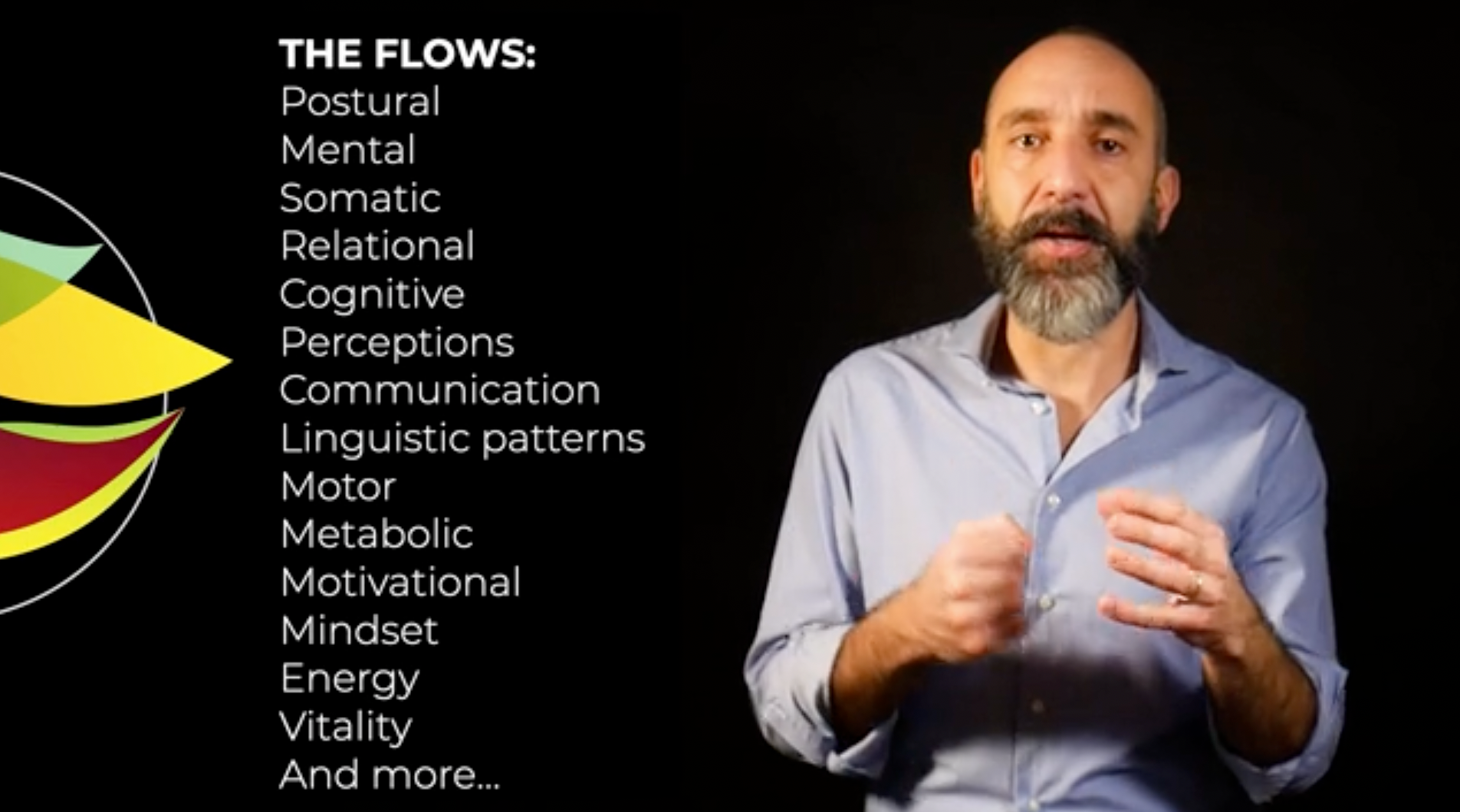
Human behaviour is complex: it is the product of different elements including personality, personal history, learnings (conscious and subconscious), motivation and needs.
It is important to use scientifically sound tools and methods to analyse it accurately in all its different shades.

The method is based on 6 main steps:
1. TRIGGER
The analysis of immediate behaviours: the way a person reacts to a stimulus (i.e. a provocation, a fright, or just the request for a commitment, etc.)
2.MULTI-LEVEL OBSERVATION
Multi-level contemporary observation (the ‘Flows’: what is said, how it is said, postural and movement changes, interpersonal dynamics, thought flows, etc.)
3. SPECIFIC PATTERNS
Recognizing specific patterns at all these levels (i.e. complaining as an initial reaction, looking for someone to blame, thought freezing, muscular freezing of a specific area of the body etc.)
4. SYNERGIES AND DYSFUNCTIONS BETWEEN LEVELS
Identifying synergies or dysfunctions between different levels (i.e. threatening words with retreating posture, rapid logical thought flows but frozen posture and social interaction requiring passive care, etc.)
5. FROM FLOWS TO NEEDS AND MOTIVATIONS
The connection between these flows and needs (specifically Ancestral Needs) and motivations that are thus satisfied or sacrificed (exploring what is missing, dysfunctions, transfers, vicariations, etc.)
6. HOW TO ACTIVATE CHANGE
Identifying practical ways to bring physiology and balance of behavioural Flows and of Needs.


BEHAVIOURAL FLOWS and ANCESTRAL NEEDS offer a practical, scientifically grounded tool to:
⇨ Identify a series of indicators (linguistic, ideative, physical, mindset, bodily, etc.) to make an initial assessment of a patient richer and more multifaceted.
⇨ Know what to look for in different flows (ideative, postural, physical, interpersonal dynamics, etc.) that people use to respond to events — more or less effectively.
⇨ Analyse them individually via clear interpretations that are scientifically based, such as understanding the influence of the three stress axes on the motor system and other psycho-neural-muscular systems on different emotions, archaic challenge rituals in social groups etc.
⇨ Evaluate them as a group considering elements of coherence and functional or dysfunctional synergy between them that can cause virtuous circles (efficiency, mastery, self-esteem), or degenerative processes at mental or physical level (psychosomatic cost).
⇨ Understand which Ancestral Needs are getting the right space, which are being satisfied and which are being sacrificed, suppressed or vicariously satisfied.
⇨ Develop strategies to create balance between different Ancestral Needs and take the Flows that shape them back to a balanced, functional state.
Get your practical solutions and tools – with solid scientific foundations –and integrate them in your care, change or development profession today.
Fabio Sinibaldi, MBPsS, PsyD
Author | Research & Development Professional | Integrative Psychotherapist | Keynote Speaker
President of the Association for Integrative Sciences
CEO & Founder of Real Way of Life
Fabio is an expert in Applied Neurosciences and PsychoNeuroEndocrineImmunology which he combines with an evolutionary and ethological standpoint.
With an international career spanning more than 20 years, he is the founder of the Association for Integrative Sciences and of the Real Way of Life research and training institutes.
Working as a clinician, researcher and trainer, he is the developer of the Integrative Sciences, the Switch Model, the Integrative Functional Patterns, Isometric Emotions techniques, Ideographic Thinking, and several other integrative techniques.
He conducts seminars on The Switch Model throughout the world.
Lecturer at post graduate schools of psychotherapy and counselling, he holds seminars for universities and institutions in different countries. Fabio regularly attends national and international congresses as a speaker.
His works are published and mentioned in various journals, magazines and academic books.
Last book published: The Switch – The Science of Change – The complete guide for driving effective change.
Practical strategies you can immediately put to use in your daily professional practice.
A powerful tool – to be used independently – or as excellent integration with psychotherapy, counselling, meditation, training labs and any setting that requires awareness of behaviour, thought, interpersonal and physical ways of being and their connection with needs and motivations.

Mattias Reilly
“At last a tool that goes beyond traditional mono-directional theories and, instead, integrates different disciplines and approaches to reach articulated and multifaceted theories. Truly effective! Thank you!”

Emma Millar
“My previous training gave me some useful keys to interpreting human behaviour, but now a whole world has opened up. I have access to an entirely new perspective and have discovered that there are different levels and facets to explore and to work on. Very useful! I am looking forward to the next insight modules.”
A tool for your work — and a lens on your own life
The more you practise reading flows and needs in others, the more you start to recognise them in yourself:
why you react the way you do, which needs you protect, where you hold back.
Understanding others and understanding yourself turn out to be the same skill.

This course is one of the Core Modules of the Integrative Sciences HUB
Like every HUB module and core technique,
it gives you NEW material EACH MONTH:
updates, operational tools, application variants, and deeper insights.
The HUB also includes regular live online meetings, practical case studies, and access to a community of professionals — group activities, peer exchange, and other ongoing initiatives.

Enroll in The HUB Today!
50% off until September 14!
180 € → only 90 € / year
≈ $103 / £80
That's access to 20+ courses — plus one new course/update every month — for less than the price of a single workshop.
* This introductory price is locked in for life: sign up at 90 €/year and you'll pay 90 € every year, never more.
(Renews automatically each year. You can cancel anytime — but most of our members choose to stay)
